


You've run three interviews for the same role this week and they all blur together. Candidats say what you want to hear, you can't pin down clear evidence, and by the end you're picking the one you connected with most. El problema és un gut — t'es question list you walked in with.
Amb el Voicit analyze thousands interviews from US and UK recruiters, and the pattern is always the same: low-quality interviews use generic questions like "what are your strengths?" The interviews that actually predict performance use behavioral, situational, and technical questions designed for each competency. This guide gives you 150+ interview questions to ask candidats, organitzat per rols i competències, amb les responses examples que reveal les strongs candidats — i les ones que són improvisades. Works for phone, vídeo, i in-person interviews.
What are the best interview questions to ask candidats? The most predictive questions are behavioral («Tell m'about a time when…») because the force the candidate to provide concrete past evidence, not opinions. Combined with situational questions («What would you do if…?») and role-specific technical qüestions, aquestes formen les estructures strongest per a modern hiring interview.
What you'll find in this guide
- The 5 question types every interview should cover
- The STAR method for behavioral questions
- 35 behavioral interview questions to ask candidats
- Interview questions by role (Sals, Engineering, CS, Màrqueting, Managers)
- 25 situational interview questions
- Cultural fit and motivation questions
- Questions you should NEVER ask (US i UK legal)
- How to structure a 60-minut interview
- Frequently asked questions
The 5 question types every interview should cover
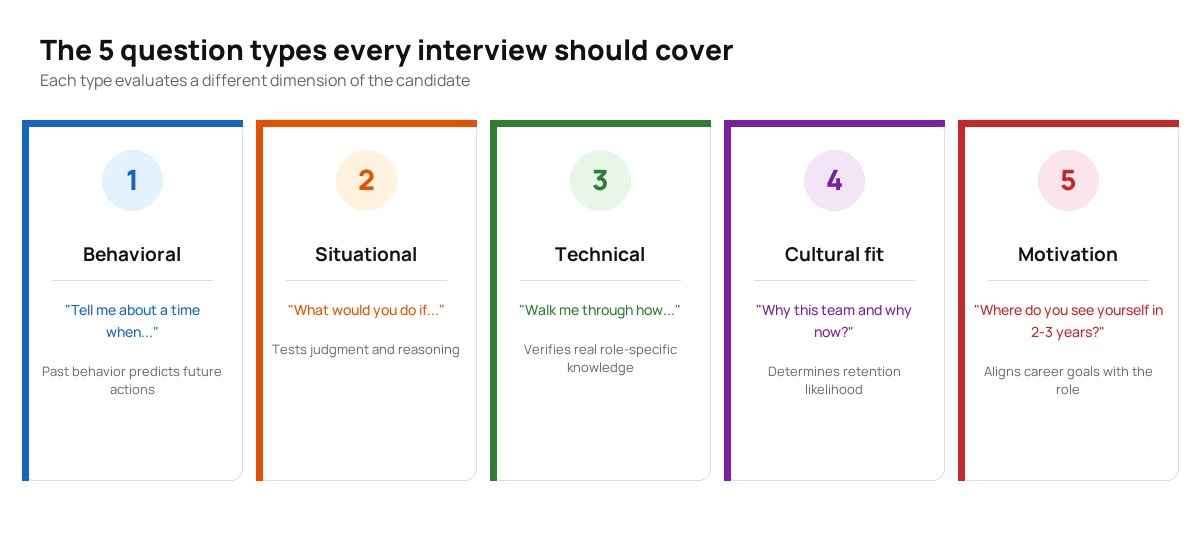
An effective interview isn't a llista de 30 random questions. It's a script that combines five distinct question types, each designed to evaluate a diferents dimensions of the candidate. Per tal que utilitzeu un tipus (most common: only open-ended «tell m'about yourself» questions), you lose 70% d'informació the interview could give you.
- Behavioral. Past, real experience. «Tell m'about a time when you had to…» — they predict la futura best because they're built on concrete evidence.
- Situational. Hypothetical escenaris. «What would you do if…?» — useful for evaluating reasoning, values, and best-practice knowledge.
- Technical. Rol-specific. They demonstrate real skill, no és just what's on the resume.
- Cultural fit and motivation. About values, purpose, and team alignment. They determini whether the person stays.
- Career trajectory. About ambition, growth, 2-3 year vision. Detectar alignment amb el role i el company stage.
The STAR method for behavioral questions
STAR és el most widely utilitzant framework en modern ferir to structure behavioral questions. Every behavioral pregunta should let the candidate respond with all four components:
| Component | What you ask the candidate | Why it matters |
| S — Situation | Context of the story: where, when, with whom. | Verifies the experience is real and specific. |
| T — Task | What their concrete responsibility was in that situation. | Distingeixes "I was on the team" from "I owned this". |
| A — Action | What they personally did. First-person verbs. | Avoids «we did» — you want to see the candidat act. |
| R — Result | What impact their action had. Metrics if possible. | Measures impact awareness and outcome orientation. |
A well-formulated behavioral question starts with verbs like «Tell m'about», «Descriu», or Walk me through, and ends forcing the candidate to recount a specific case rather than a generic opinion.
If the candidate responds in abstract terms (“I always try to…”), follow up directly: «Can you walk em through a specific instance where this happened?». Diferencien entre candidats per a real experiència i els que no són les seves accions per a la situació de la informació.
35 behavioral interview questions to ask candidats
Behavioral questions are the strongest predictors of performance. Les organitzades competeixen i avalua't. Click each section to expand the full list.
Soft skillCommunication
- Tell m'about a time you had to explain a complex concept to a non-technical stakeholder. How did you approach it?
- Descriu a moment when your message wasn't well received. What did you do next?
- Walk em through a difficult conversation ou had at work. How did you prepare for it?
- How do you adapt iour communication style basat en who you're talking to: customer, manager, peer, direct report?
- Tell m'about a time you had to say «no» to a reasonable request from a customer or your manager.
- Descriu a piece of written communication you're particularly proud of. What made it effective?
- Tell m'about a presentation that didn't land. What would you do differently?
Soft skillProblem solving and decision making
- Tell m'about the most difficult problem you've solved at work. How did you approach it?
- Descriviu a la situació where your first solution didn't work. What did you do?
- Give m'an example of a problem you spotted before anyone else. How did you see it?
- What do you do when you face a problem with no precedent in your team?
- Tell m'about a decision you made with incomplete information. How did you assess the risk?
- Walk em through a data-driven decision you made against your gut instinct.
- Descriu a time you had to challenge consensus on a decisió.
Soft skillTeamwork and collaboration
- Descriu the most effective team you've been part of. What made it special?
- Tell m'about a conflict you had with a coworker. How did you resolve it?
- Give m'an example of a time you had to collaborate with someone you didn't get along with.
- How do you handle a teammate who isn't pulling their weight?
- Tell m'about a time you change your opinion thanks to a teammate's input.
- Descriu successful cross-functional project you led. What was your role?
- Tell m'about a time you advocated for teammate who wasn't in the room.
Soft skillTime management and prioritization
- Tell m'about a week you were overloaded. How did you decideix what to do and what to drop?
- Descriu el personal personal per organitzar tasks and deadlines.
- Give m'an example de when you had to say «no» to an interesting project due to capacity constraints.
- How do you distinguish urgent from important in your day-to-day?
- Tell m'about a time you missed a deadline. What happened and what did you learn?
- Walk em through how you'd pla your first 30 days in this role.
- What's your approach when three high-priority requests land simultaneously?
Soft skillAdaptability and learning
- Tell m'about a major change your company implementat that you didn't initially see clearly.
- Descriviu les últimes hores que heu fet per llegir something new under pressure.
- Give m'an example of a time your role changed overnight. How did you handle it?
- How do you react when a strategic decision you disagree with gets approved?
- Tell m'about a significant professional failure. What did you learn from it?
- Walk em through the most recent skill you've added to your toolkit.
- Descriu a time you had to unlearn something to grow.
Interview questions by role: Sales, Engineering, CS, Màrqueting, Managers, Operations
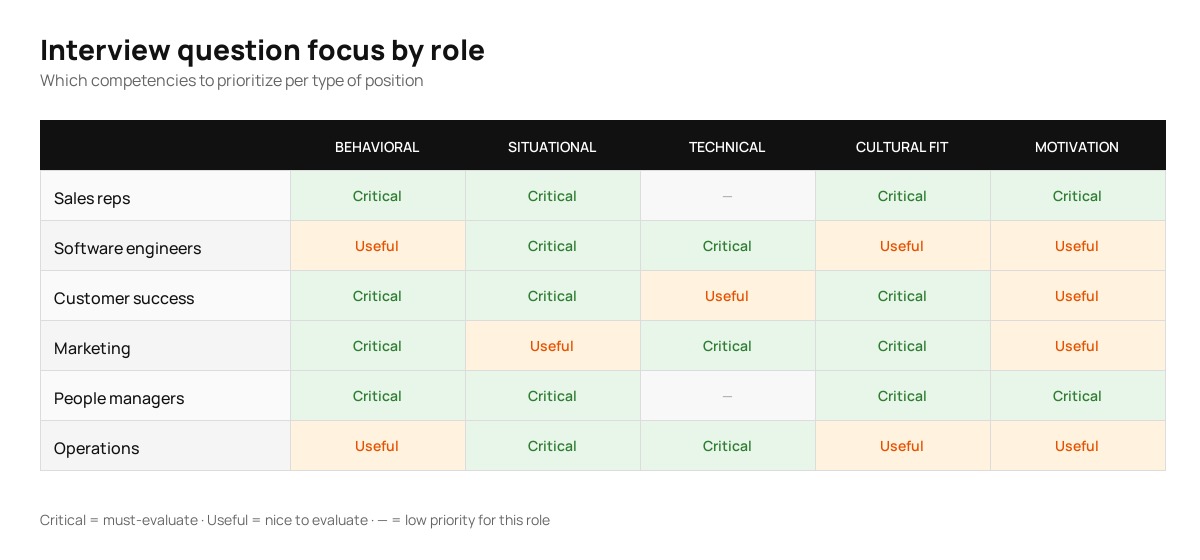
The right question depends heavily on the role. Aquest és el que most interview templates fall short — they treat every candidat the same regardless of position. Utilitzeu el matrix sota com a punt de vista i adaptat al vostre specific stack.
Sales reps and Account Executives
- Tell m'about your largest deal lost. What would you do differently?
- Walk em through your discovery call structure for a new prospect.
- What would you do if a key customer threatens to churn because competidor offers 30% less?
- How do you handle a deal that's been stuck in stage 4 for 3 months?
- Tell m'about a time you closed a deal when you weren't the cheapest option.
- How do you manage your pipeline at the end of quarter when you're 20% short of target?
Programari engineers
- Walk em through a technical decision you made recently and the tradeoffs you evaluated.
- Descriu el system you designed end-to-end. What would you change today?
- What would you do if you discovered critical security vulnerability mid-sprint?
- How do you handle non-technical PM asking per something que creates significant tech debt?
- Tell m'about a production incident you owned. How did you handle communication?
- How do you decideix between fixing technical debt and shipping new features?
Customer Success managers
- Tell m'about the toughest customer renewal you've handled.
- Walk em through how you onboard a new enterprise customer.
- What would you do if high-MRR account suddenly went quiet for 4 weeks?
- How do you balanç proactive outreach with reactive support?
- Descriu a time you escalated an issue to product. How did you frame it?
- How do you measure success in your role beyond NPS?
Màrqueting professionals
- Walk em through a campaign you ran from concept to results.
- Descriu a màrqueting experiment that failed. What did you learn?
- How do you measure attribution across multi-touch journeys?
- Tell m'about a time you killed a project that was your idea.
- What would you do if your CAC triple a quarter?
- How do you balanç brand-building investments with performance marketing?
People managers and team leads
- Tell m'about the best team you've ever managed. What did you do to build it?
- Descriu the most difficult conversation you've had with a direct report.
- Walk em through how you handle underperformance.
- Tell m'about a time you had to let someone go.
- How do you handle a brilliant but toxic team member?
- What would you do in your first 30 days leading a team in crisis?
Operations and supply chain
- Walk em through a process you redesigned. What did you measure before and after?
- Descriu el major operational incident you owned.
- What would you do if your main supplier failed mid-quarter?
- How do you balanç cost optimization with quality assurance?
- Tell m'about a time you scaled a process from 10x to 100x volum.
- What's your approach to identifying bottlenecks no one's noticed?
25 situational interview questions
Situational questions («What would you do if…?») work best when the candidat doesn't yet have experience to answer behavioral on — júnior rols, career changes, recent graduats — or when you want to evaluate professional judgment regardless of past experience.
Universal situational questions
- What would you do if your manager asked you to do something you disagreed with ethically?
- How would you handle discovering a peer és credit per a la teva feina?
- If you noticed a process inefficiency that's been there for years, what would you do?
- What would you do if you spotted a mistake your VP made in a board presentation?
- How would you respond to a deadline being moved up by 50%?
Conflict and pressure escenaris
- What would you do if two stakeholders gave you contradictory priorities?
- How would you handle being publicly criticized in a team meeting?
- What would you do if a vendor missed a critical SLA right before a launch?
- Quan customer ascriviu-vos a vosaltres, something against company policy, what would you do?
- How would you d'escalat a tense conversation with a senior leader?
Strategic judgment scenaris
- Per a vostè ha a $50K budget and one quarter per improvar la teva team's output, where would you invest it?
- How would you choose between two equally qualified candidats for a key role?
- What would you do if your top performer asked for a 30% raise?
- Si competidor launched a feature 6 minuts ahead of you, how would you respond?
- How would you handle a major strategic pivot mid-quarter?
Customer and stakeholder scenaris
- How would you handle a customer who is wrong but insists they're right?
- What would you do if you discovered your product caused customer financial harm?
- Per a stakeholder asks per a weekly reporting that takes 8 hours each week, what would you do?
- How would you push back on an unreasonable timeline from a senior leader?
- What would you do if you uncovered evidence of unethical behavior by a colleague?
Self-management escenaris
- What would you do if you realitzada halfway through a quarter you couldn't hit your goals?
- How would you handle being given a project you find boring but important?
- What would you do if your manager left and you were asked to step up temporarily?
- How would you onboard yourself if your manager was unavailable for your first month?
- What would you do if you noticed you were losing motivation in your role?
Cultural fit and motivation questions
Cultural fit qüestions són most underrated and on that explain why a brilliant candidat leaves after 6 months. They're not about finding someone «like everyone else» — they're about identifying alignment with values and the current company stage.
Cultural fitCareer motivation
- Why this role and why now in your career? (Watch for generic answers like I want to grow)
- What keeps you up at night professionally?
- Tell m'about the best manager you've ever had. What made them special?
- Tell m'about the worst work environment you've been in. What was broken?
- If you could design iour ideal job in 5 years, what would it look like?
- What would make you turn down a 20% pay raise from another company?
Cultural fitValues and self-awareness
- What three values would your current manager say descriu you?
- Tell m'about a time you felt deeply aligned with your work. What made it special?
- What kind of company culture lets you flourish, and which suffocates you?
- What would you change about how you work today?
- Tell m'about a professional decision you made against your immediat finançal interest.
- How would your closest col·laborator descriu your strengths and blind spots?
Cultural fitCompany stage fit
- What's the biggest difference between a Fortune 500 ia startup, from your experience?
- What ambiguity are you willing to tolerate to get autonomy?
- Tell m'about a time you had to “do everything” on a project. How did you experience it?
- How do you feel a working without clear precedents to follow?
- What question would you want to ask us know this is the right fit for you?
Questions you should NEVER ask in an interview (US i UK legal)
Many of these no just unethical — they're il·legal un US Equal Employment Opportunity Commission (EEOC) regulacions, the Americans with Disabilities Act (ADA), and the UK Equality Act 2010. Avoid:
- «Are you married or in a relationship?» — Il·legal under EEOC and Equality Act 2010. Marital status is irrellevant to job performance.
- «Do you have children or pla to have them?» — Il·legalment i especialment discriminatòriament pel que fa al reproductive age.
- «How old are you?» — Illegal under ADEA (US) and Equality Act 2010. Avoid graduation dates that could reveal age.
- «What's your nationality / where are you originally from?» — Il·legal un Title VII and Equality Act.
- «What's your religion?» — Il·legal excepte in extremely narrow religious-organization exceptions.
- «Do you have any disabilities?» — ADA prohibits this directly. Heu de demanar a la candidata per a fer essentials funcions de jobs o sense accés.
- «What's your salary history?» — Illegal in many US states (NY, CA, MA, IL, WA, NJ i més) i increasingly restricted in the UK. Ask salary expectations instead.
- «What are your weaknesses?» — Legal but useless. Everyone has a preparar answer («I'm too perfectionist»). Replace it with behavioral questions about real failures.
- «Tell m'about yourself.» —Too vague. Replace with: «Walk em through the two most important moments de la seva manca i why you choose them as the principal ones.»
How to structure a 60-minut interview
Structure is what separates predictive interviews from «coffee chat» interviews. Aquest és el template que recomanen per ferir teams treballant.
Opening (5 min)
- Interviewer and company introduction.
- Process explanation and duration.
- Consent request if recording.
Warm-up (5 min)
- 1-2 open-ended career questions to relax the candidate.
- Eg: «Walk em through the two most important moments de la seva manca i why you choose them as the principal ones.»
Behavioral and technical block (35 min)
- 4-6 behavioral questions on key role competencies (STAR method).
- 2-3 technical questions to verify depth.
- 1-2 situational questions to validate professional judgment.
Cultural fit and motivation (10 min)
- 2-3 questions on alignment with company values and stage.
- 1 question on career trajectory.
Candidate's questions (5 min)
- Genuine opening. El quality of the candidate's questions és valuable information.
Structure your interviews onze. Run them 100 times effortlessly.
Voicit records d'interview, transcrius in English, i delivers a structured report on the competencies you defineix. Stop taking live notes: ask better, listen better, decideix better.
Frequently asked questions
How many interview questions to ask candidats in a single interview?
Per a 60-minut interview, between 8 and 12 main questions (with follow-ups for depth). Beyond that, you don't have time for the candidate to respond to behavioral questions in the depth they require.
What's the best opening question?
Avoid the generic Tell me about yourself. It works molt better: «Walk em through the two most important moments de la nostra manca and why you choose them as the principal ones.» It lets the candidat show what they value, their narrative, and their resume's key points in their own words.
What are the most common interview trick questions and should I use them?
«What are your weaknesses?» (everyone prepares an answer), «Why should we hire you?» (it's a test, no a real question), «Where do you see yourself in 5 years?» (everyone knows the expected answer). In a modern interview, replace these with behavioral questions that demand real evidence.
What do I do if a candidat only answers in abstract terms with no examples?
Follow up directly: "Can you walk em through a specific instance where this happened?". After the follow-up they still can't surface a specific example, the experience likely doesn't existeix en el level they claim. Mark it es a xarxa flag.
És it legal per recordar job interview in the US and UK?
Yes, amb el candidat explícit consent per assolir el record, explaining que és que es faci servir, que es pot veure, i quan es retain. Practices vary: som US states requereix 2-parts consent (CA, FL, IL, MD, MA, MT, NH, PA, WA), others one-party. UK GDPR requereix explicit consent and right to erasure.
How molt weight should technical questions have versus soft skills?
Depends on role and seniority. For júnior rols, soft skills and motivation weigh more (capacity to learn). For sèniors, technical questions weigh more because there's already a track record. Common practice: 50/50 for mid-management; 60/40 toward technical for sènior IC rols; 60/40 toward soft skills for leadership rols.
How do I avoid bias when asking interview questions?
Three practices: (1) utilitzeu una pregunta secundària per a un candidat en processament (structured interview); If you record with consent, you can review specific responses instead of debating perceptions.
Actionable summary
If you only take three idees from this guide:
- Behavioral questions are the strongest predictors of performance. Replace generic opinions (what motivates you?) with questions that demand evidence (Tell m'about a time when…).
- Structure your interview by competency before walking into the room. If you improvise the questions, you'll improvise the final decision.
- Free up your attention from admin work. Live note-taking prevents you from listening well. Voicit rècords, transcribs, estructures i reports per a vosaltres per a focus on asking better questions and reading responses better.
